

If you want the one-paragraph answer: no, the Australian labour market shows no AI-driven upheaval. The report's first key point is that unemployment (4.2 per cent as at February 2026) is lower than at any point in the decade before COVID, employment-to-population is 64.0 per cent, and underutilisation, at 5.5 per cent, is well below its pre-COVID average. But underneath the strong aggregates, DEWR's Office of the Chief Economist went looking for the specific fingerprint AI would leave, slower growth in the occupations most amenable to automation by generative AI, and found a faint one.
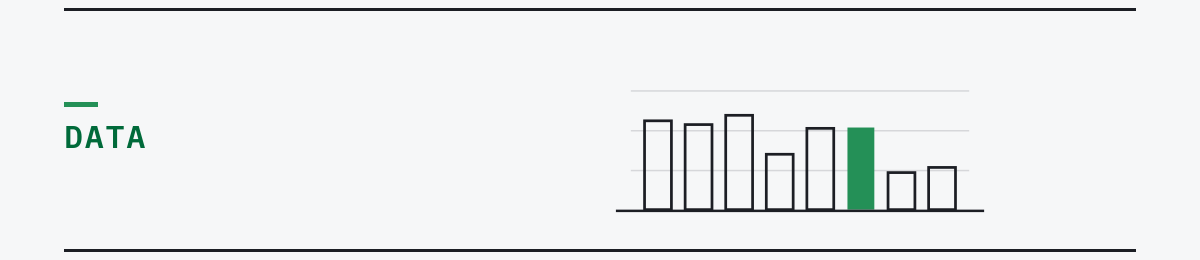
The gap: 5.6 versus 9.5
Source: DEWR, AI and employment in Australia (July 2026), occupations grouped into quintiles by Jobs and Skills Australia's generative-AI automation exposure scores across 355 ANZSCO occupations. Bars proportional to the growth rates. Accessed 11 July 2026.
DEWR's statistical model (quarterly data, February 2015 to February 2026) sharpens the same picture: an occupation with AI exposure one standard deviation above average had employment "about 2% lower by February 2026 than it would have been under its pre-ChatGPT trend."
Now the part that makes this report worth trusting, because the department volunteers it: "This is not definitive evidence of job loss caused by AI." The negative relationship is not statistically significant under two alternative exposure measures, nor when the COVID period is excluded from the pre-treatment sample. DEWR's own instruction for reading the result: it "should therefore be read as justification for ongoing monitoring rather than clear evidence that AI has reduced employment." A government department publishing a finding alongside the two tests that weaken it is rarer than it should be, and it is exactly what makes the finding usable.
The counter-example everyone assumes, disproven in the same tables
The most-discussed "AI took my job" occupation, software development, does not show it in the aggregate Australian data: 'Software and Applications Programmers' employed 199,000 people in February 2026, up 25 per cent, 40,000 more people, since November 2022. And within the most-exposed fifth, the report finds "no common employment trend": some exposed occupations are up since ChatGPT, some down. Vacancies tell a similar non-AI story, falling more than a third across every exposure quintile from the post-COVID hiring peak, which is what a cooling labour market looks like, not a targeted cull.
Who is actually exposed: women with degrees, not trades
The report's Table 2 quietly corrects a decade of popular imagery about automation. The least-exposed fifth of occupations, carers, electricians, truck drivers, cleaners, carpenters, plumbers, is 69.5 per cent male, with 14.9 per cent holding a bachelor degree or higher. The most-exposed fifth, general clerks, programmers, accountants, receptionists, accounting clerks, is majority female (43.7 per cent male) and 43.7 per cent degree-qualified. Age and migrant status barely vary across the quintiles. In Australia's own data, generative-AI exposure is a white-collar, feminised, credentialed phenomenon, which matters for who retraining policy should actually be aimed at.
Against the $116 billion promise
Seven months before DEWR counted what has happened, the Productivity Commission published what could: its Harnessing data and digital technology inquiry report estimated AI could add "about an extra $116 billion" of GDP over the next decade. The number has since circulated as if it were a forecast. The report itself calls it "a back of the envelope estimate", built on a judgement that multifactor productivity gains "above 2.3%" are likely, within a survey range running from 0.5 to 13 per cent, with a $26 billion figure at the low end. Held against DEWR's measured data, the honest summary of Australia's AI economy in mid-2026 is: the productivity dividend is a wide projection, the job losses are a fragile signal, and both documents say so in their own text if you read past their headline numbers. DEWR commits to keep counting; its 5.6-versus-9.5 gap and the "about 2% below trend" estimate are now the baseline every future claim, boosterish or doomy, can be checked against. We will be checking.